
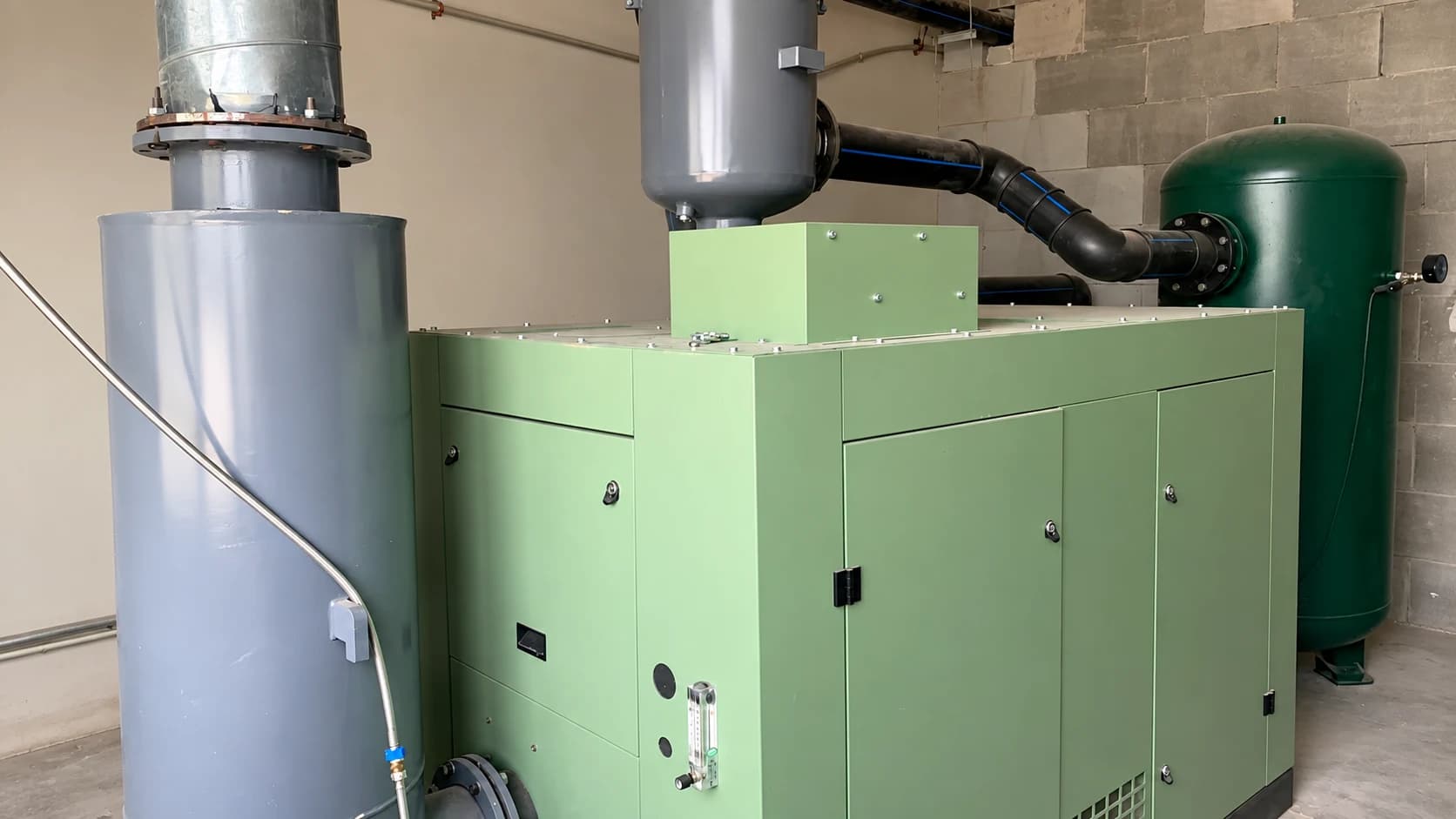
Ambient temperature can change how a dry screw vacuum pump runs because it shifts the pump's thermal condition. The pump depends on controlled clearances between the rotors and between each rotor and the pumping chamber. If that combined thermal condition moves beyond the range covered in the design, thermal expansion can alter those clearances. Volumetric efficiency may fall and, in a severe case, the rotors may begin to contact. The selected model and duty determine the permitted range and the appropriate cooling arrangement.
Ambient temperature is only one input. Inlet-gas temperature, compression heat, cooling-water condition, ventilation, operating duration, and the pump location all influence the temperature seen by the rotor set and pumping chamber. A warm workshop may be workable with the right arrangement, while a low outdoor temperature does not by itself confirm a suitable installation. We need to know whether the complete system can hold the reviewed thermal condition through the duty.
Our engineering team saw this during a 2021 development test of an anonymous water-cooled dry screw vacuum pump. In the hotter daytime test, volumetric efficiency was below design expectation, and a shutdown inspection found slight rubbing marks between the rotors. We repeated the test under cooler ambient and inlet conditions, with cooling water held at approximately 25°C, and the pump reached its design expectation. The sections below keep that observation in its test context, then cover the clearance review and installation data needed for a model-specific decision.
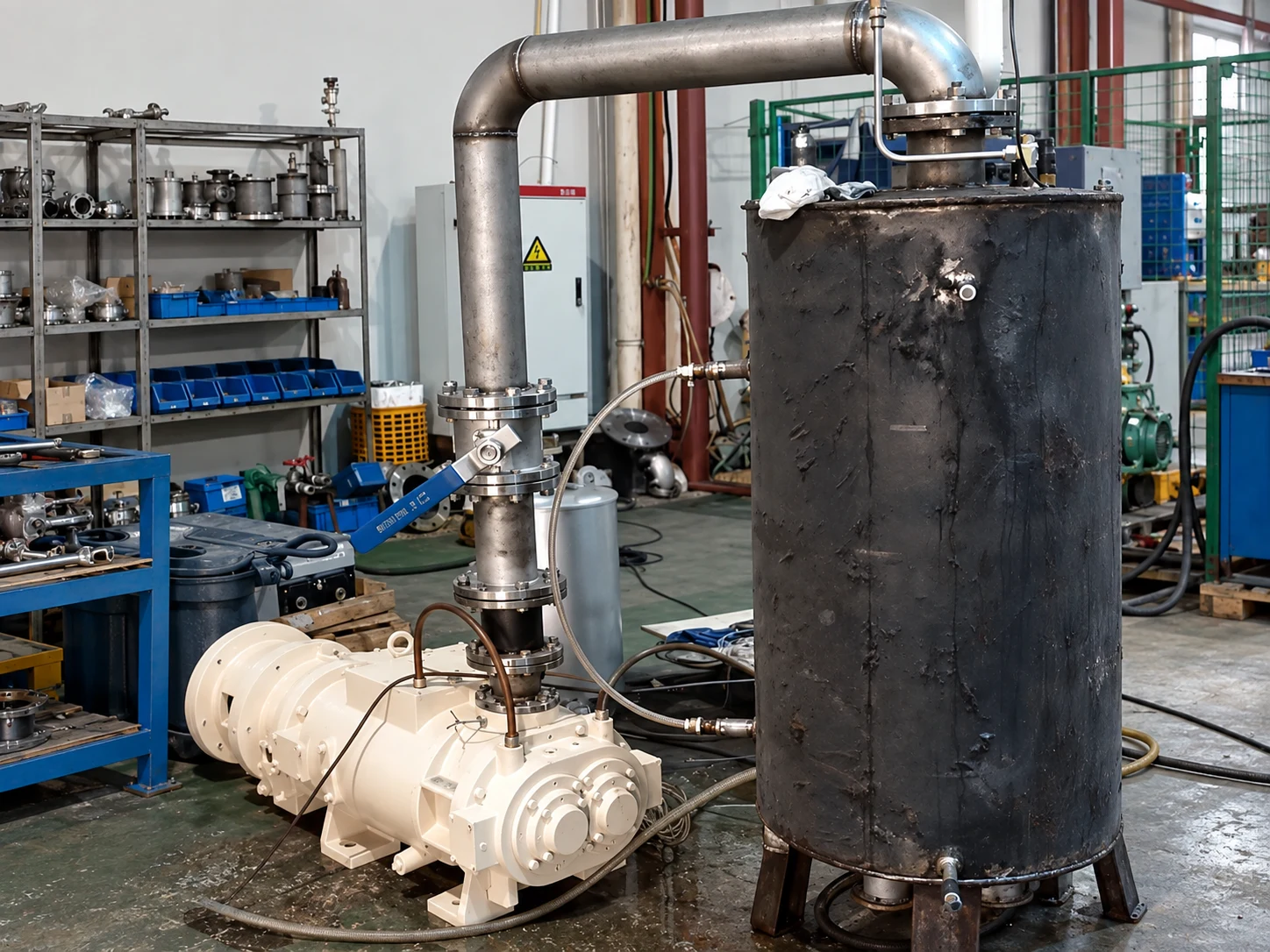
Why Must Ambient Temperature Be Reviewed With the Installation Environment?
Ambient temperature affects how readily the pump package can reject heat. The value that matters is the temperature around the installed pump, not only the temperature reported for the city or region.
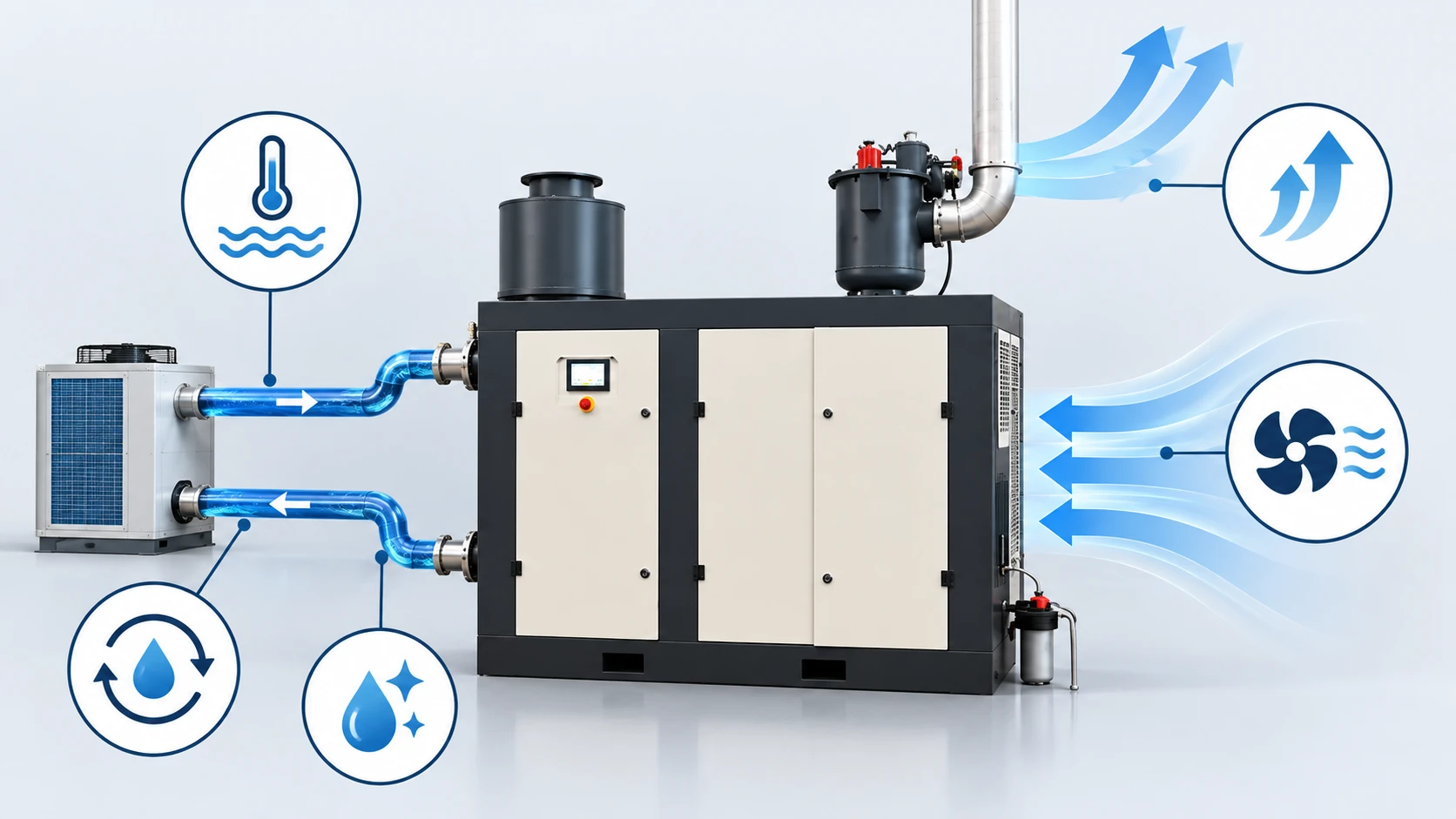
A dry screw vacuum pump generates heat as it moves and compresses gas from the suction to the discharge. The pump housing, cooling arrangement, connected piping, motor area, and nearby air all affect how that heat leaves the package. Hotter surrounding air, restricted cooling air, or warm discharge air returning to the pump inlet area leaves less room for heat rejection. We check that the selected package has a clear cooling-air path, the required clearances, and an unobstructed route for warm air to leave.
This applies to a pump installed indoors, outdoors, inside a housing, or close to a process heat source. A regional maximum temperature is a useful starting point, but it does not show whether the pump location has sun exposure, hot-air recirculation, poor ventilation, adjacent equipment, or an enclosure temperature above the surrounding room.
| Installation question | Why it matters | What we need |
|---|---|---|
| Where will the pump be installed? | Indoor, outdoor, enclosed, and process-adjacent locations create different thermal conditions. | Pump location, shade or weather protection, nearby heat sources. |
| How does air move around the package? | The package needs a clear path for supply air and warm discharge air. | Ventilation layout, wall clearances, exhaust-air route, nearby equipment. |
| Is cooling water available? | A water-cooled pump needs stable cooling-water conditions. | Water availability, supply temperature, quality, and continuity. |
| What enters the pump? | Gas, vapor, condensable material, dust, and liquid carryover change the protection and configuration review. | Gas or vapor condition, inlet temperature, contamination risk, condensation risk. |
| How does the pump run? | Continuous, cyclic, and intermittent operation place different thermal demands on the pump. | Duty cycle, starts and stops, expected load changes, operating hours. |
We therefore ask for the temperature at the pump location. A regional weather value cannot show the installation condition around the package. The reading at the pump helps us check the relevant model limits and installation details.
Installation layout and heat buildup
Summer weather can raise the temperature around a pump, but the installation layout can do the same. A poorly ventilated room can retain heat from several machines. If one package directs warm discharge air toward another, the downstream pump takes in warmer cooling air. Covers, ducts, filters, and clearance around the package must follow the installation requirements for the selected model.
Each site needs its own cooling review. Before recommending a model or package, we confirm how the room supplies cooling air and removes the heat released by the equipment. In cold conditions, we also check material limits and whether process vapor or by-products can condense during operation or shutdown.
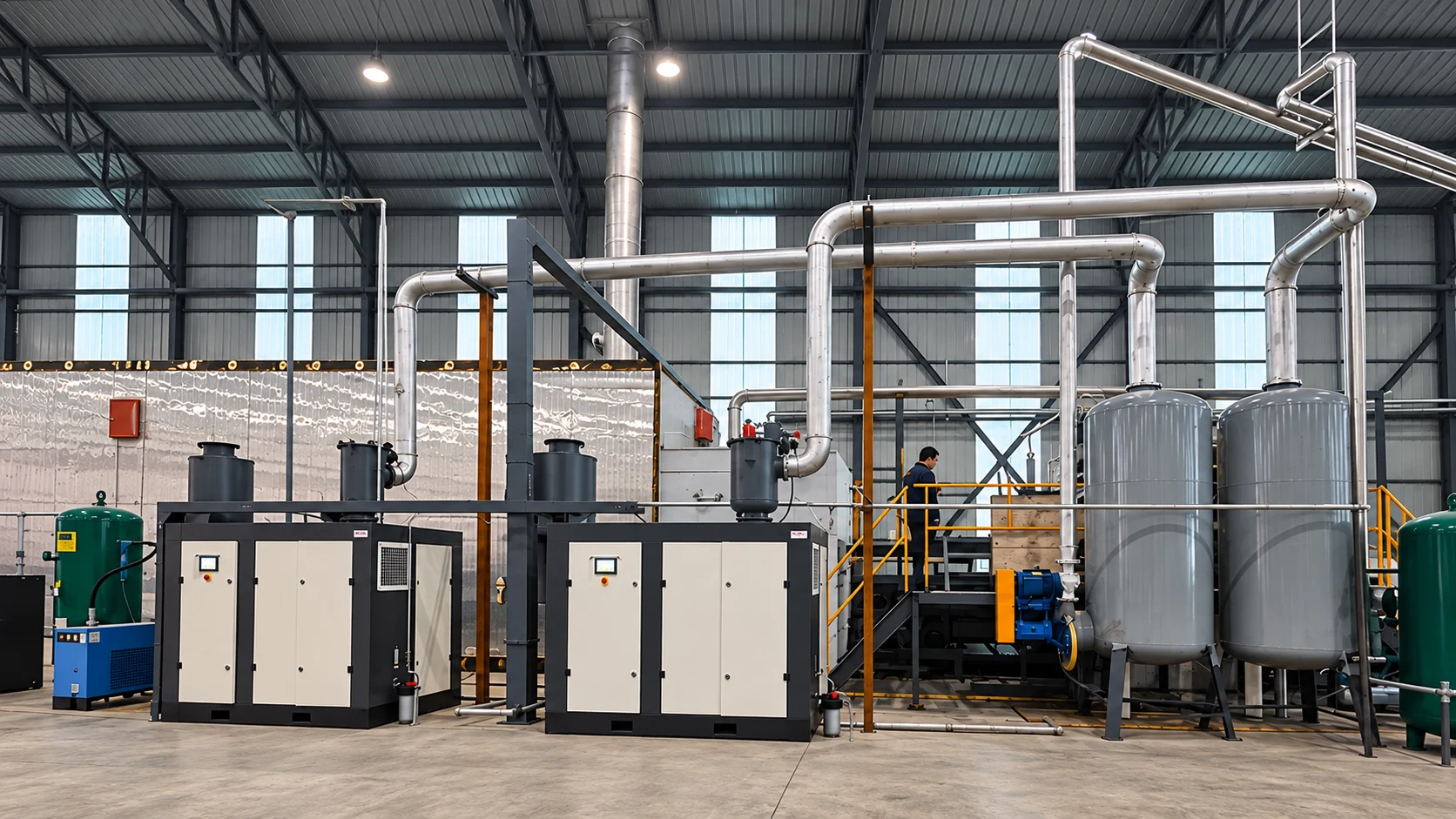
How Do Rotor and Pumping-Chamber Clearances Respond to Temperature?
Dry screw vacuum pumps run with controlled clearances between the two rotors and between each rotor and the pumping chamber. Those clearances allow the rotors to run without contact and support the pump's expected performance within the conditions covered by its design.
As the rotors turn in synchronism, they create moving volumes that carry gas from the suction side to the discharge side. There is no sealing liquid inside the pumping chamber. Rotor and chamber geometry, material choice, cooling arrangement, process temperature, and the design operating range all set the clearance condition the pump is designed to maintain.
Materials expand or contract as their temperature changes. NIST defines thermal expansion as a change in a body's dimensions as temperature rises.1 For a dry screw pump, ambient air is one part of the picture. Inlet-gas temperature, compression heat, cooling performance, operating duration, and process heat all affect the rotor set and pumping chamber. If these conditions move beyond the range covered in design and validation, thermal expansion can alter the designed clearance relationship.
| Thermal input | What it changes | What we need to confirm |
|---|---|---|
| Ambient temperature | The conditions for rejecting heat from the package. | Temperature at the pump location, ventilation, and possible warm-air recirculation. |
| Inlet-gas temperature | The heat carried into the pumping path. | Inlet-gas temperature and process medium when comparing duties. |
| Compression and duty | Heat generated during operation and the time available for the pump to reach a stable temperature. | Whether the duty is continuous, cyclic, or intermittent, plus run duration. |
| Cooling condition | How much heat the cooling arrangement can remove. | Cooling-water temperature, availability, and the requirements for the selected model. |
| Gas or vapor condition | Condensation, deposits, material compatibility, purge, and discharge conditions. | The process medium and its vapor or condensation behavior before confirming the temperature conditions. |
A peer-reviewed study of twin-screw vacuum pumps examines clearance distribution, thermal deformation, leakage, and pump performance together.2 The same linked effects guide our engineering review when a pump operates outside the thermal conditions considered for its configuration. We check clearance-related effects, leakage, pumping performance, and possible contact alongside the inlet condition, cooling condition, contamination, and test point. Ambient temperature starts the review; the selected model and duty determine the permitted range and the likely consequence.
Clearance changes and pumping performance
Pump performance depends on the clearance remaining close to its design value. A larger gap between the rotors, or between a rotor and the pumping chamber, allows more gas to leak back from a higher-pressure region and can reduce volumetric efficiency. If thermal expansion leaves too little clearance, the rotors can rub against each other or the pumping chamber, and the pump may need inspection or repair.
The amount and direction of the change depend on the pump design and the test conditions. When a result falls below the design expectation, our engineering team checks the inlet state, cooling condition, operating point, run duration, instrumentation, rotor condition, and any deposits or contamination before reaching a conclusion.
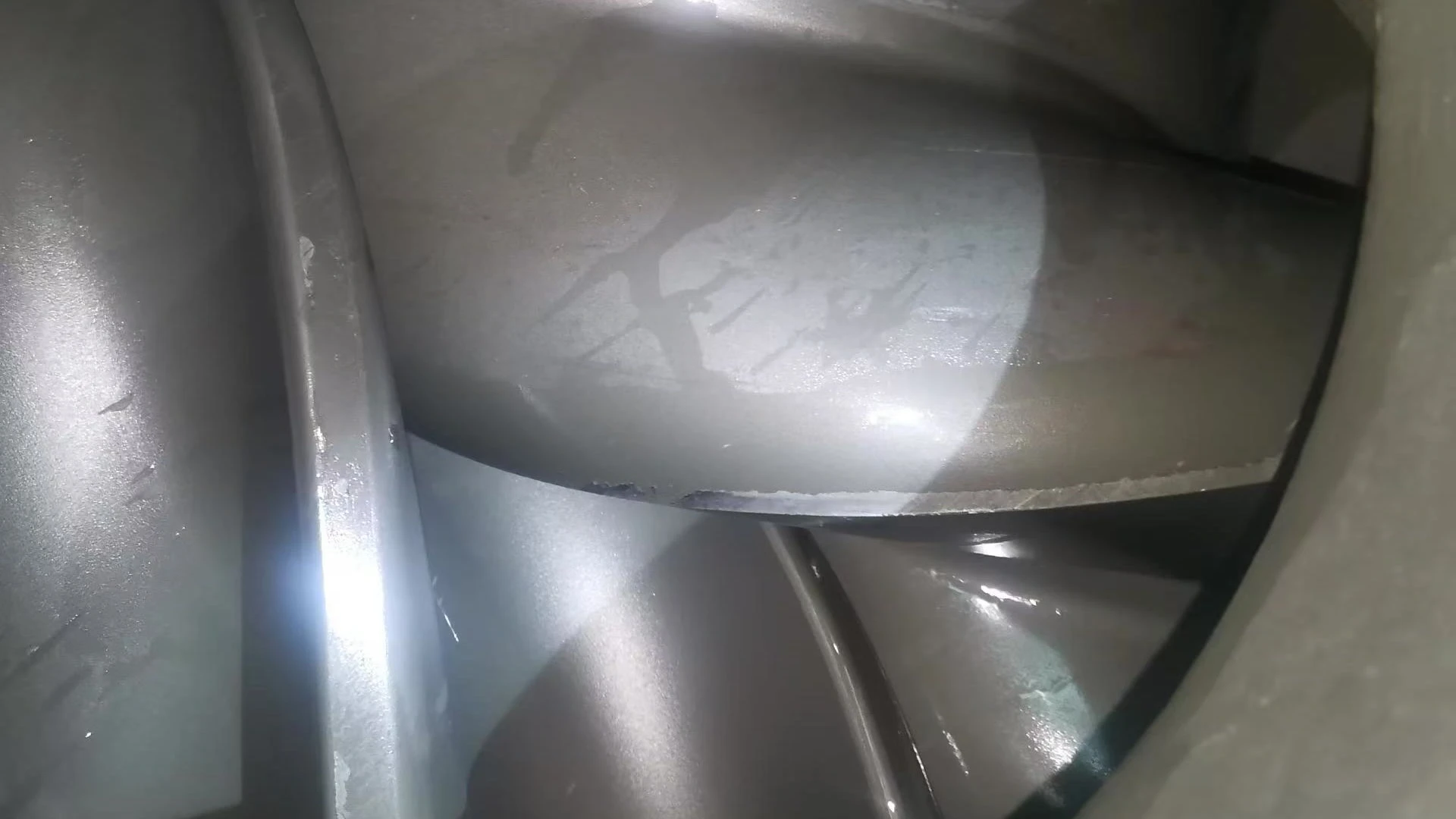
What Did Our Engineering Team Observe During a 2021 Development Test?
In a 2021 development test, our engineering team found that an anonymous water-cooled dry screw vacuum pump delivered lower-than-expected volumetric efficiency during a hot daytime test. A repeat test, completed after ambient and inlet temperatures had fallen and with cooling water held at approximately 25°C, reached the design expectation. This was an observation from one pump and one test setup.
The daytime test took place during summer 2021 as part of production research and development. Ambient temperature reached approximately 40°C at the hottest point of the day. The test used non-circulating water rather than a circulating cooling-water arrangement, and the water temperature had risen above 30°C. Under these conditions, the measured volumetric efficiency was below the design expectation. After shutdown, our engineering team found slight rubbing marks between the rotors.
We repeated the test at night after the ambient temperature had fallen. Ambient temperature and inlet-gas temperature were both approximately 20°C, and cooling water was held at approximately 25°C. Under those conditions, the measured volumetric efficiency reached the design expectation. The result gave our engineering team a reason to review ambient temperature, inlet-gas temperature, and cooling water together for this pump.
| 2021 development-test record | Daytime test | Night-time repeat test |
|---|---|---|
| Pump tested | Anonymous water-cooled dry screw vacuum pump | Same pump |
| Ambient temperature | Approximately 40°C | Approximately 20°C |
| Inlet-gas temperature | Approximately 40°C | Approximately 20°C |
| Cooling arrangement | Non-circulating water, above 30°C | Cooling water held at approximately 25°C |
| Volumetric efficiency | Below design expectation | Reached design expectation |
| Inspection after shutdown | Slight rubbing marks between the rotors | No further observation published |
This case gives our engineering team a practical review rule: ambient temperature, inlet-gas temperature, and cooling conditions must be considered together. All three changed between the daytime and night-time tests, so the records do not separate the contribution of each one. For another pump, its model documentation and duty determine the permitted temperature range and cooling requirement.
When we review a new installation, we check the temperature at the pump location, inlet-gas temperature, cooling utility, gas stream, duty, and installation layout together. A high ambient temperature can be manageable when the selected model and cooling arrangement cover the required duty. The final check is made against the model documentation and the operating conditions for that site.
How Should Cooling Be Reviewed for a Dry Screw Vacuum Pump?
Cooling helps control the temperature of the rotor set and pumping chamber. We check the cooling method, available utility conditions, and control requirements against the selected model and process duty.
In the 2021 development test, the pump reached its design expectation when lower ambient and inlet temperatures were combined with cooling water held at approximately 25°C. Since ambient temperature, inlet-gas temperature, and cooling water all changed between the two tests, our engineering team treats the result as a combined thermal condition for that pump. A university research paper on a single-head screw vacuum pump examines rotor thermal deformation and cooling methods.3 It provides independent support for reviewing thermal deformation, clearance design, and cooling together.
For a water-cooled pump, we check available cooling-water temperature, continuity, quality, flow rate, connection arrangement, and, where relevant, shutdown or storage conditions. For an air-cooled arrangement, we check package clearances, room ventilation, air cleanliness, exhaust-air direction, and the temperature of air entering the cooling path. Hot gas, condensable vapor, dust, corrosive components, or intermittent liquid carryover add further questions to the pump and process review.
Cooling review sequence
1. Define the duty: working pressure, required volumetric flow rate, gas or vapor condition, inlet temperature, and duty cycle.
2. Map the installation: pump location, ambient-temperature range, enclosure or outdoor condition, ventilation, adjacent heat sources, and exhaust-air route.
3. Review cooling conditions: cooling arrangement, available utilities, and the permitted operating conditions in the model documentation.
4. Review the connected system: inlet protection, drainage, piping, discharge condition, site safety requirements, and maintenance access.
5. Confirm the final configuration with the selected model documentation.
Which Site and Process Details Do We Need Before Reviewing a Dry Screw Vacuum Pump?
To review a dry screw vacuum pump for site temperature, we need the operating point and installation conditions together. A temperature value or an existing pump model gives only part of the duty.
We start the initial review with working pressure and required volumetric flow rate. We then check the ambient-temperature range at the planned pump location, inlet-gas temperature, gas or vapor condition, duty cycle, cooling conditions where applicable, liquid carryover or dust risk, discharge arrangement, and site restrictions.
Installation and operating-condition checklist
- Ambient temperature at the planned pump location: minimum, maximum, and typical.
- Installation setting: indoor, outdoor, enclosed, shaded, or beside process equipment.
- Ventilation: airflow path, package clearances, and any warm exhaust air that could return to the package.
- Working pressure and required volumetric flow rate.
- Gas or vapor: composition, inlet-gas temperature, condensable-vapor condition, liquid carryover, and dust risk.
- Operating schedule: continuous, cyclic, batch, or intermittent.
- Cooling arrangement and available utilities when water cooling or another controlled arrangement is under review.
- Connected system: inlet piping, discharge route, drainage, electrical and control conditions, safety constraints, and maintenance access.
This checklist is a guide for the review, not a form that must be complete before the first conversation. We can start with working pressure, required volumetric flow rate, and the expected ambient-temperature range, then identify the remaining inputs during the project review.
When Do Ambient Conditions Need a Model-Specific Review?
A model-specific review is needed when site or process conditions approach the limits in the selected pump's documentation, or when the available information is not enough to check those limits. Ambient temperature, inlet-gas temperature, cooling conditions, process medium, and installation layout all belong in that review.
The review compares the site conditions with the documentation for the selected model. A general guide can frame the questions, while the final configuration is confirmed from the model documentation, design review, and site data. Pumps in the same technology category can still have different environmental and utility limits.
Start the technical review with the known working pressure, required volumetric flow rate, expected ambient-temperature range, planned installation setting, and cooling-water availability. We then identify whether the next check concerns the pump model, cooling arrangement, ventilation layout, gas condition, or connected system.
Conclusion
Ambient temperature changes the thermal condition around a dry screw vacuum pump. Because the pump depends on controlled clearances between the rotors and pumping chamber, we review ambient temperature with inlet-gas temperature, cooling conditions, duty cycle, working pressure, required volumetric flow rate, and the installation environment.
One 2021 development test shows how that review works. An anonymous water-cooled dry screw vacuum pump recorded volumetric efficiency below the design expectation in a hotter daytime test with non-circulating water above 30°C. In a cooler repeat test with cooling water held at approximately 25°C, it reached the design expectation. This is a development-test record for one pump; for a new project, we confirm the cooling arrangement against the selected model and duty.
For an unusual ambient-temperature range, enclosed installation, hot inlet gas, condensable vapor, or uncertain cooling conditions, start the review with the known working pressure, required volumetric flow rate, temperature range, and planned installation setting.
References
- 1. National Institute of Standards and Technology (NIST), Thermal Expansion glossary entry. Evidence role: general thermal-expansion definition only; it does not address vacuum-pump design.↩
- 2. Clearance distribution design and thermal deformation analysis of variable-pitch screw rotors for twin-screw vacuum pumps, Vacuum (2023), DOI: 10.1016/j.vacuum.2023.111936. Evidence role: peer-reviewed support for the relationship between clearance, thermal deformation, leakage, and performance in the studied twin-screw design; it does not define SC model limits.↩
- 3. He Xinxiang and Gan Shuyi, Thermal Deformation and Cooling of Single Head Screw Vacuum Pump Rotor, Chinese Journal of Vacuum Science and Technology (2026), DOI: 10.13922/j.cnki.cjvst.202209014. Evidence role: academic support for thermal-deformation and cooling analysis in the studied single-head screw pump; it does not validate the 2021 SC engineering-team test or prescribe an SC configuration.↩